

Manufacturing Intelligence · 2026 Benchmarks
2026 Manufacturing Benchmarks
The KPIs top performers use to improve OEE and reduce COGS, and how far ahead of the industry average they really are.
June 2026 · Executive Insights

01 · Why these benchmarks matter more than ever
The manufacturers gaining ground are not working harder. They are measuring smarter.
Leaders in 2026 face a paradox: more data than ever, yet too slow to act on it. The organizations closing this gap outperform peers on every major financial and operational metric.
5 pts
An OEE gap of five points between two comparable plants can represent millions in lost annual throughput. Top performers treat KPIs as living instruments, not annual reports.
The 2026 KPI snapshot
Six benchmarks that separate top performers from the rest
industry average top quartile
Executive outcome more sellable output from the assets you already own: capacity without capex.
Executive outcome cash released from stock: better cash flow and a lighter balance sheet.
Executive outcome lower scrap and rework cost, protected margins, stronger customer trust.
Executive outcome predictable delivery, lower unit costs, fewer expedite fees.
Executive outcome capital available for growth instead of trapped in operations.
Executive outcome the compound result: pricing power, cost control, and efficiency in one number.
Benchmarks reflect broad industry aggregates. Results vary by vertical, product complexity, and operating model.
02 · The metric that drives manufacturing efficiency
OEE, decomposed
Availability × Performance × Quality = OEE
Availability
Scheduled time equipment is actually running. Every downtime event reduces this component.
Performance
Speed relative to rated capacity. Micro-stops and reduced rates erode this silently each shift.
Quality
Output meeting spec on the first pass. Defects consume machine time without producing sellable units.
62→80
For a plant running 16 hours a day, moving from 62% to 80% OEE recovers several additional hours of capacity per shift, without adding a single piece of equipment.
Plants that deploy real-time OEE monitoring surface 15–25% more downtime events in the first 90 days. Operations didn't get worse; visibility got better. You cannot improve what you cannot see.
03 · The true cost of inefficiency
Inventory turns, quality, and where the cash hides
Inventory turns tell you how much cash is sitting idle. Low turns also signal deeper issues: weak forecasting, supplier misalignment, or scheduling gaps.
Stock on hand at a $50M manufacturer
$3.3M in working capital freed, without touching revenue.
First-pass yield is where quality becomes a profitability problem. The cost of poor quality runs 5–15% of total revenue. For a $200M manufacturer, that is $10–30M in recoverable value, hidden in overhead, logistics, and customer-service costs.
23%
of manufacturing executives cite real-time COGS visibility as their top financial-management gap. By month-end close, weeks of margin erosion have already occurred.
The systems of the last decade were built to record what happened. Executives now need systems that show what is happening, and what is likely to happen next.
04 · Featured strategy
Improving OEE and reducing COGS without major capital investment
The largest recoverable gains come from better use of existing assets, not new equipment. Five strategies top manufacturers apply today:
Shift to predictive maintenance
Schedule maintenance on equipment health, not a calendar. Unplanned downtime drops immediately.
Optimize changeovers
Cutting changeover time 30% with SMED adds capacity to every shift, on every line.
Connect scheduling to real-time inventory
Scheduling against theoretical inventory ripples disruption across the operation. Integrated data eliminates it.
Move quality inspection to the source
Catching defects before they consume more processing cuts rework cost and speeds root-cause resolution.
Deploy real-time shift dashboards
When supervisors see OEE, throughput, and quality live, they intervene before small deviations become shortfalls.
From data to business performance
What SAP Cloud ERP changes for the executive team
When production, inventory, procurement, quality, and finance flow through one integrated system, in real time, the KPIs in this report stop being a reporting exercise and become levers you can pull.
Real-time visibility
Monitor production orders, work-center performance, and operations as they happen.
Business outcomes
• Faster operational decisions
• Less downtime
• Higher throughput
Cost transparency
Identify cost variances before month-end.
Business outcomes
• Protect margins
• Reduce waste
• Improve profitability
Integrated inventory planning
Synchronize production, inventory, and procurement in real time.
Business outcomes
• Lower inventory costs
• Fewer stockouts
• Better cash flow
Scalability without complexity
Cloud ERP designed for growth.
Business outcomes
• Lower IT costs
• Faster expansion
• Enterprise capability without enterprise complexity
Manufacturing success story
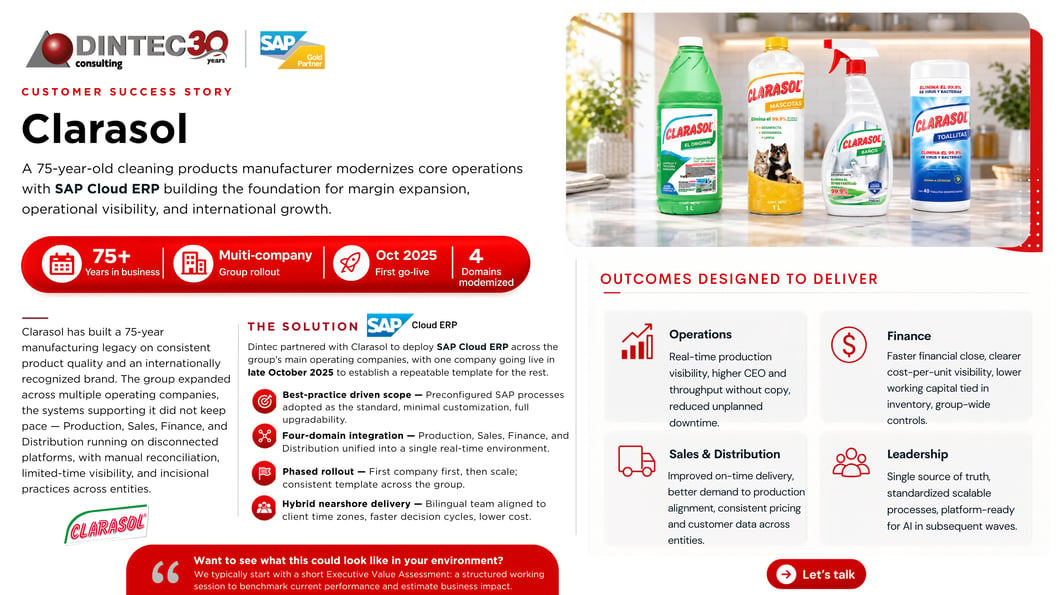
See how CLARASOL improved manufacturing performance with SAP Cloud ERP.

The benchmarks in this report aren't theoretical. CLARASOL, a leading consumer-products manufacturer, applied this same approach: real-time visibility, integrated planning, and disciplined KPI management with SAP Cloud ERP to strengthen production performance, cost control, and decision-making across its operation.
05 · The executive takeaway
High-performing manufacturers don't just measure KPIs.
They act on them.
SAP Cloud ERP transforms operational data into faster decisions, stronger margins, and sustainable growth.
The result isn't better reporting. It's better business performance.
Ready to improve your manufacturing KPIs?
Explore what's possible with a personalized SAP Cloud ERP demo built around your business.
©2026 DINTEC Consulting · Manufacturing Intelligence · Executive Insights